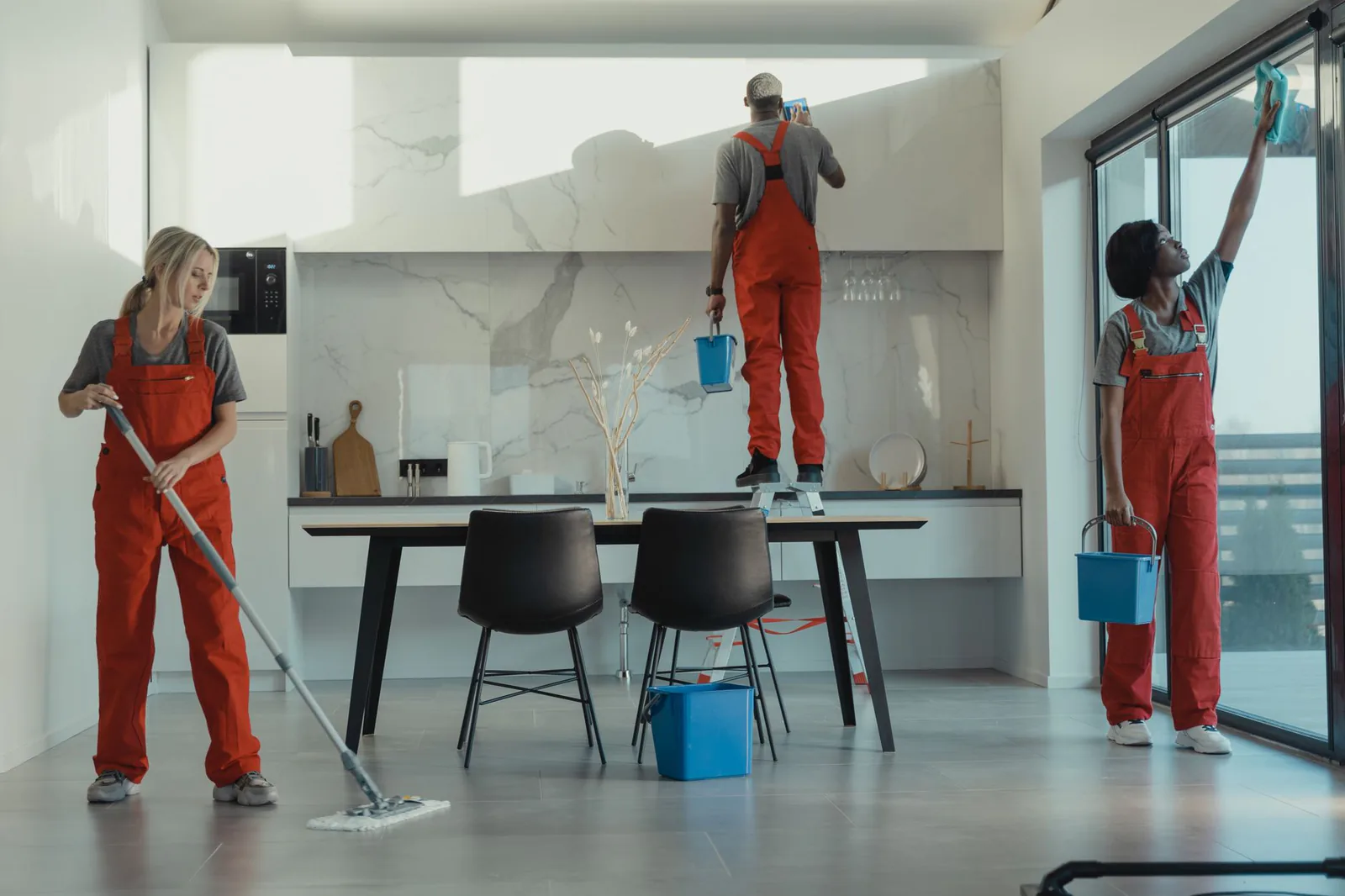
SAN FRANCISCO, CA (SATIRE) — When the AI bubble finally popped — not with a bang, but with the quiet, deflating hiss of a $40 billion valuation settling to $4.50 and a LinkedIn post — the tech industry's newly unemployed did what any self-respecting class of displaced knowledge workers would do. They pivoted. They didn't pivot to Web3, or to spatial computing, or to whatever comes after agentic AI (which is, as far as anyone can tell, "more agentic AI but with a different font"). They pivoted to cleaning.
Within six months of the Great AI Deflation of 2026, an estimated 340,000 former prompt engineers, vibe coders, AI ethicists, and "Head of Generative Strategy" title-holders had registered cleaning businesses. The Bay Area alone saw 12,000 new LLCs with names like "PromptClean," "ScrubGPT," and "Agentic Dustbusters LLC." The California Secretary of State's office reportedly ran out of "doing business as" forms and had to start issuing them on napkins.
"I spent four years building a large language model that could write marketing copy," said one fictional former ML researcher, now the proud owner of "Sparkle Intelligence," a residential cleaning service in Oakland. "Turns out the model was better at writing marketing copy than I was at anything. But you know what the model can't do? It can't scrub a toilet. It can't mop a floor. It can't show up at 8 AM with a bucket and a good attitude. I can do all of those things. I am, as of this month, the most employable person I know."
The Pivot Nobody Saw Coming
The cleaning business boom caught every economist, venture capitalist, and LinkedIn thought leader off guard. They had predicted that displaced AI workers would flood into adjacent fields — data engineering, cloud architecture, "AI safety consulting," a category that did not exist until people needed a new thing to put on their LinkedIn. Nobody predicted that the natural successor to "Head of Generative AI Strategy" would be "owner of a small business that cleans offices for $45 an hour."
But the logic, once you heard it, was impeccable. Cleaning is the anti-AI industry. It is physical. It is local. It cannot be done remotely. It cannot be automated by a chatbot. No one has ever said, "We're replacing our janitorial staff with a fine-tuned model." The product is tangible — a clean floor, a sanitized countertop, a streak-free window — and the customer can verify the results with their own eyes, which is more than anyone could say about the output of a "generative content pipeline."
"The thing about AI," said one fictional former vibe coder, now operating "Dust & Reason Cleaning Co." in Austin, "is that you could never tell if you were doing a good job. You'd ship a feature and six months later someone would ask what it did and you'd say, 'It generates text,' and they'd say, 'Yes, but what is it for,' and you'd stare at them like they'd asked you to explain the concept of time. With cleaning, nobody asks what it's for. The floor is dirty. Now it's clean. That's the whole product. It's the most honest work I've ever done."
The Naming Wars
The first crisis of the cleaning boom was not a shortage of mops or a surplus of dirty offices. It was a crisis of branding. Former tech workers, conditioned by a decade of startup culture to believe that a good name was worth more than a good product, spent weeks agonizing over what to call their cleaning businesses. They hired freelance brand consultants — other former tech workers who had pivoted to "naming strategy" — and conducted customer discovery interviews and built mood boards and ran A/B tests on logo concepts.
The results were predictable. The country was suddenly flooded with cleaning businesses whose names sounded like failed Series A startups. "CleanOps." "Hygiene-as-a-Service." "SanitizationOS." "MopML." One enterprising former AI safety researcher in Brooklyn registered "Alignment Cleaning," with the tagline "We make sure your floors match your values." Another, a former prompt engineer in Seattle, named her business "Few-Shot Janitorial," explaining that "we only need to see your mess once to know how to clean it."
For those still struggling to find the right name, industry experts — a new category of consultant that had also pivoted from something else — recommended browsing curated lists of cleaning business names to find inspiration before the good ones were all taken. They were being taken fast. By August 2026, the U.S. Patent and Trademark Office reported a 4,000% increase in cleaning-related trademark filings, with "ScrubAI" alone filed by 17 different entities in 11 different states.
The VC Pivot
Naturally, venture capital followed. Within months of the cleaning boom, at least three Sand Hill Road firms had announced dedicated "clean-tech" funds — a term that, in a previous life, had referred to solar panels and carbon capture, but now referred to companies that owned mops. Andreessen Horowitz reportedly led a $50 million Series A into "CleanChain," a cleaning business that used blockchain to verify that floors had been mopped. The company had 14 customers, all of them other cleaning businesses founded by people who had previously worked at companies funded by Andreessen Horowitz.
"We're very excited about the cleaning vertical," said one fictional partner, speaking from a conference room that had not been cleaned in three weeks because the building's cleaning service had been replaced by a startup that was still in beta. "It's a $80 billion total addressable market. It's highly fragmented. There's no dominant platform. And the unit economics actually work, which is a refreshing change from everything else we've funded in the last five years."
The Irony Is Not Lost
The great irony of the cleaning boom — and everyone acknowledged it, because former tech workers love acknowledging irony almost as much as they love acknowledging that they used to work in tech — was that AI had spent three years promising to eliminate repetitive, manual labor, and the people who built it had ended up doing the most repetitive, manual labor imaginable. They had built machines that could write poetry and generate images and hold conversations, and then they had gone to clean the offices of the people who still had jobs.
"I trained a model that could generate a 50-page market analysis in four seconds," said one fictional former AI researcher, now the owner of "Broom & Bloom," a residential cleaning service in Denver. "And now I spend four hours cleaning one house, and at the end of it, the house is clean, and I feel something I never felt in five years of model training. I feel like I did something real. I feel like I made a thing better. I feel like I touched grass. Literally. I touched grass. I was on my hands and knees scrubbing a patio."
"The AI revolution was supposed to free us from drudgery," said Dr. Fictitious N. Hypothetical, a fictional labor economist at the University of Madeup. "Instead, it freed the drudgery from the AI workers. They built a machine to do the thinking, and then the machine did the thinking, and they went back to the mopping. In a sense, it's the most perfectly circular outcome in the history of technology. In another sense, it's just very, very funny."
The Revolution Was Mopped
At press time, the cleaning boom showed no signs of slowing. New cleaning businesses were registering at a rate of 800 per week. The Bay Area, once the undisputed capital of artificial intelligence, was now the undisputed capital of artificial cleanliness. Former prompt engineers were comparing mop brands with the same intensity they had once brought to comparing model benchmarks. Former AI ethicists were writing Substack newsletters about the ethics of using bleach. And somewhere in San Francisco, a large language model was generating a press release for a cleaning business called "Sudsy Intelligence," and nobody was reading it, because everyone was too busy actually cleaning.
The future, it turned out, was not artificial. It was sanitized. And it smelled like lemon pine-scented floor cleaner, which was, by universal consensus, a significant upgrade from the previous smell, which had been "open-plan office with a broken espresso machine and a venture capitalist."