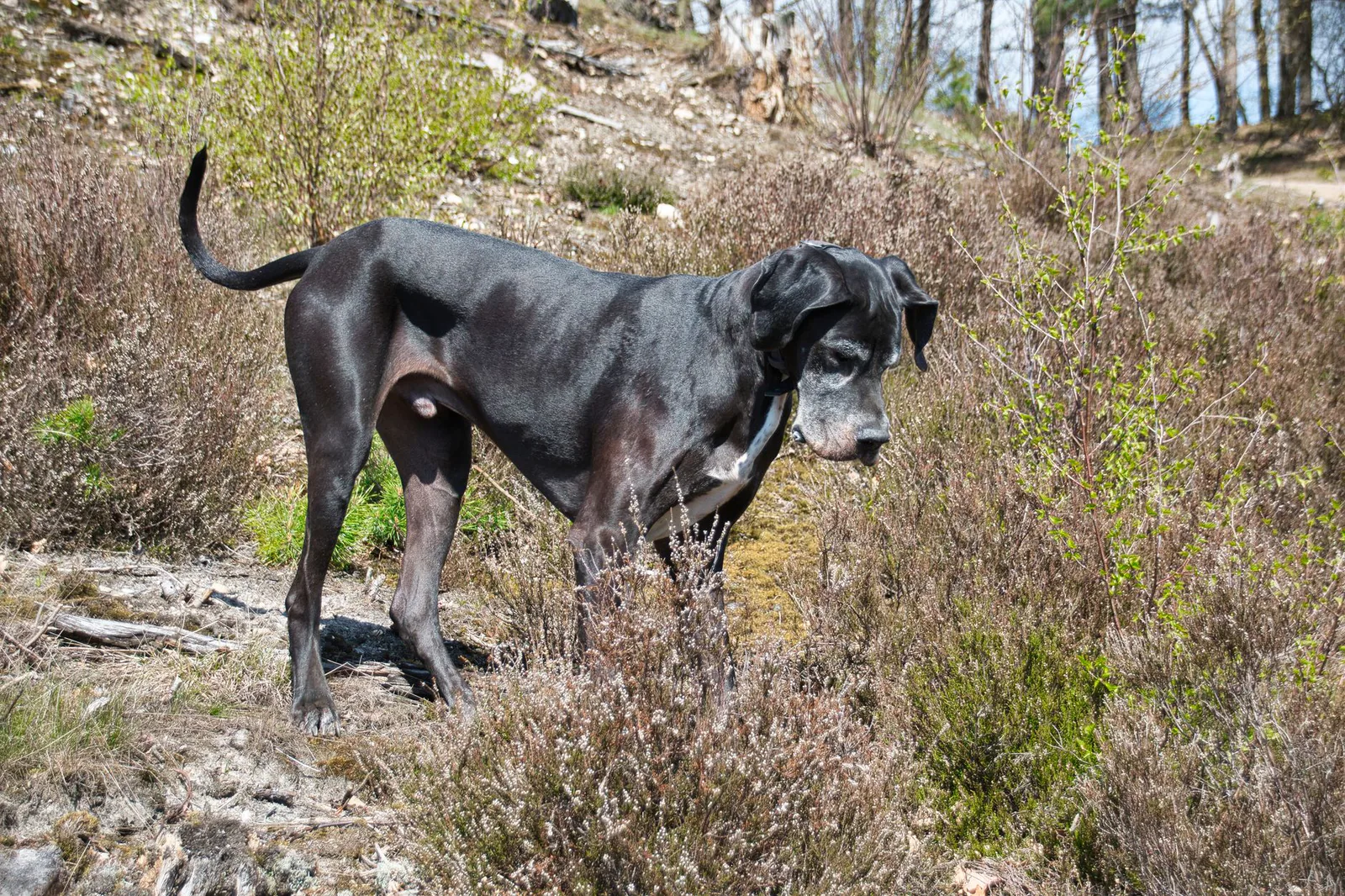
BROOKLYN, NY (SATIRE) — When Karen Henderson brought home a eight-week-old Great Dane puppy named Goliath, she described the experience as "love at first sight." Her apartment — a modest 600-square-foot one-bedroom in Williamsburg — described the experience as "a structural emergency." Eighteen months later, Goliath weighs 175 pounds, stands 6'2" on his hind legs, and has consumed approximately $14,000 in food, three couches, one mattress, and a door frame that he walked through without noticing it was there. Karen loves him. Karen is also, by her own admission, "living in a gentle prison."
The giant dog industry — and it is an industry, make no mistake — has spent the last decade convincing Americans that bigger is better, that a 180-pound dog is just a 10-pound dog with more to love. The marketing is relentless. Instagram accounts with millions of followers show Great Danes draped across sofas like living blankets, Mastiffs leaning against their owners with the quiet devotion of a bodyguard, Saint Bernards carrying fictional barrels of brandy to rescue people in snow. What the Instagram accounts do not show is the sofa replacement bill, the knee surgery, the food budget that rivals a human child's, or the moment when a 200-pound dog decides he is a lap dog and sits on your chest at 3 AM because he heard a noise.
"People see the photos and they think, 'Oh, what a gentle giant,'" said Dr. Marcus Fictitious, a fictional veterinarian who specializes in large-breed dogs. "They don't see the photos of the living room after a Great Dane with a tail like a baseball bat gets excited. I've seen televisions knocked off walls. I've seen coffee tables cleared in a single wag. That tail is not a tail. It is a weapon of mass decoration."
The Food Economy
The first thing giant dog owners discover is that they have entered a new economic tier of pet ownership. A Chihuahua eats roughly $300 of food per year. A Great Dane eats roughly $300 of food per week. This is not an exaggeration — it is a conservative estimate that assumes your dog is not one of those Great Danes who, through some metabolic miracle, seems to convert kibble directly into mass at a rate that would intrigue a nuclear physicist. Giant breed dogs consume between 5 and 10 cups of high-quality kibble per day, which translates to a bag of dog food every two weeks and a quiet, growing realization that you are now budgeting for a dog the way other people budget for a car payment.
"I used to eat out four times a week," said one fictional owner in Chicago, who asked to remain anonymous because she did not want her family to know she had cancelled her own meal subscription to afford her Mastiff's food. "Now I eat ramen so that Brutus can eat salmon. He eats better than I do. He also weighs more than my refrigerator. This is my life now."
The Tail Incident
Every giant dog owner has a tail story. The tail of a Great Dane or a Mastiff is not a gentle, wagging appendage. It is a bone-covered whip that moves with the force of a metronome powered by diesel fuel. It clears coffee tables. It knocks glasses off counters. It strikes children at exactly head height. It leaves bruises that owners explain to coworkers with phrases like "Oh, no, it's fine — the dog got excited."
One fictional owner in Austin described the moment her Great Dane's tail swept a full glass of red wine across her white living room wall. "It happened in slow motion," she said. "He was happy. I was happy. And then the tail went — whoosh — and suddenly I had a Jackson Pollock painting on my wall and a dog who was very pleased with himself. The wall is still stained. I've decided it's art."
Then there is the phenomenon known in the giant dog community as "the happy clearing," which is when an excited dog enters a room and, through sheer tail velocity and body mass, removes every object from every surface below four feet. Laptops, phones, drinks, remote controls, small children — nothing is safe. One owner in Denver described coming home to find her Newfoundland had "greeted" her by sweeping the entire kitchen counter clear of a birthday cake, a fruit bowl, and a stand mixer. "He was so happy to see me," she said, surveying the destruction. "He was the happiest dog in the world. My kitchen looked like a crime scene."
The Lap Dog Delusion
Perhaps the most dangerous aspect of giant dog ownership is the persistent, unshakeable belief held by the dogs themselves that they are small. Every Great Dane, every Mastiff, every Bernese Mountain Dog is convinced, at a fundamental cognitive level, that it is a 12-pound lap dog. They will attempt to sit on your lap. They will attempt to climb into bed with you. They will attempt to curl up on a couch cushion that is roughly the size of one of their thighs. And they will look at you with an expression of such pure, confused devotion that you will let them, because saying no to a 180-pound dog who wants to be held is, emotionally, somewhere between impossible and a war crime.
"At night, he gets into bed with me," said one fictional owner in Portland, describing her English Mastiff, who weighs 210 pounds. "He gets in slowly, like he's being sneaky. He is not being sneaky. The bed shakes. The frame creaks. I can feel my ribs compress. And then he sighs — this big, contented sigh — and he puts his head on my chest, and I lie there in the dark, unable to breathe, thinking, 'This is love. This is what love feels like. It feels like being slowly crushed by something that smells like kibble and drools on your face.'"
The Veterinary Sticker Shock
If the food doesn't bankrupt you, the vet bills will. Everything about a giant dog costs more — not proportionally more, but exponentially more. Medication is dosed by weight, which means a Great Dane taking the same antibiotic as a Beagle requires roughly eight times the dose. Surgery requires a team large enough to lift the dog. X-rays require a bigger machine. Anesthesia requires more drugs and a vet who is comfortable putting under an animal that weighs as much as an adult man. One fictional owner in Seattle received a quote for her Mastiff's knee surgery that was higher than her own deductible for the same procedure on a human knee. "I have health insurance," she said. "He does not. I am now the kind of person who has a veterinary credit card. I never thought I'd be here."
And the lifespan. This is the part that the Instagram accounts truly do not show. Giant breeds live, on average, 7 to 10 years. Some less. The math is brutal: you spend $15,000 a year on a dog who will be with you for less than a decade, who will grow to the size of a small horse in the first year, and who will break your heart in a way that a smaller dog — simply by virtue of sticking around longer — might not. The joy is compressed. The grief is enormous. It is, in the most literal sense, a big love in a small window.
The Puppy That Ate Manhattan
The insidious thing about giant breed puppies is that they are, for approximately four months, the same size as regular puppies. They are small. They are round. They have enormous paws that they haven't grown into yet, and they wobble when they walk, and they fit in your arms, and you think, "This is fine. This is manageable. How big could he really get?"
Then the growing begins. Giant breed puppies gain weight at a rate that would be alarming in any other context — sometimes two to three pounds per week, sometimes more. They do not grow gradually. They grow in sudden, terrifying spurts, so that you leave for work on a Tuesday with a 40-pound puppy and come home to a 55-pound dog who has somehow also learned to reach the kitchen counter. By six months, they are 100 pounds. By a year, they are 150. By two years, they are whatever God intended, which is usually "larger than your furniture was designed to accommodate."
This is why prospective giant dog owners should consult a puppy weight predictor before bringing home that adorable eight-week-old ball of fur. Knowing in advance that your "little guy" will soon weigh as much as a refrigerator is not a buzzkill — it is a survival strategy. It is the difference between entering a relationship with eyes open and waking up one morning to discover that the puppy you carried home in a tote bag now requires a furniture dolly.
The Honest Truth
Here is the thing that every giant dog owner knows and none of them will tell you until you already own one: they would do it again. All of it. The food bills, the tail incidents, the crushed ribs, the couch replacements, the vet bills that arrive in envelopes thick enough to be small books. They would do it again because a giant dog loves you with a physicality that smaller dogs cannot match. When a 180-pound dog leans against your leg, you feel it. You feel the weight of devotion. You feel the warmth of an animal that has chosen you, specifically, as the person it will slowly destroy with affection.
"He's the best thing that ever happened to me," said Karen Henderson, looking at Goliath, who was at that moment attempting to fit his entire head into a cereal box. "He's also the most expensive, the most destructive, and the most logistically complicated. He is a living, breathing natural disaster that I invite onto my bed every night. And I wouldn't trade him for anything, except maybe a slightly smaller version of him that still had the same personality. But that doesn't exist. So here I am. Here we are. Goliath and me, against the world, and also against my furniture, and also against my bank account."
"Owning a giant dog is like being in a relationship with a very large, very loving person who doesn't understand their own strength, eats everything in your kitchen, and will one day break your heart by leaving too soon," said Dr. Fictitious. "But for some reason — and science has not yet determined what it is — the people who do it once almost always do it again. It's the dog world's version of having a second child. You know what's coming. You do it anyway. Something about the size of the love makes the size of the cost feel worth it."
At press time, Goliath had eaten Karen's third couch cushion of the month, knocked a lamp off a side table with his tail, and fallen asleep across the entire bed, leaving Karen approximately six inches of mattress and one pillow. She posted a photo to Instagram. It got 14,000 likes. The comments said, "What a gentle giant." Karen did not correct them.